
6 Month — Advanced Course in Aviation Law
CPD-certified advanced training in aviation law, regulation, and compliance.



Skills you'll learn

Learning aviation law with EBC is truly an enriching experience. The modules and classes are well-structured, offering a clear and practical understanding of the subject. The guidance of teachers made even the most complex topics easy to grasp. This course helped me build a solid foundation in aviation law. I would highly recommend it to every law student exploring this dynamic field
Ishita Pandya, 5th year law student
I have always been a stickler for mastering specialized subjects and Aviation Law had long fascinated me. As a regular user of EBC Learning portal, I was thrilled when EBC introduced the Programme in Aviation Law in collaboration with Grayspace Academy and Prof (Dr.) V. Balakista Reddy. I enrolled immediately. The live classes, projects, and exams were conducted with such rigor that I truly felt like I was back in college. It was an immersive experience that demanded commitment and offered immense value. Authentic insights and structured learning, this course gave me the depth and clarity to develop my expertise in the law of airspace, aerodromes and the complex dynamics of aviation.
Pallavi Barua, Advocate-on-Record, Supreme Court of India
Pursuing the Advanced Programme in Aviation Law was a transformative experience. The well-structured curriculum gave me deep insights into national and international aviation frameworks. The faculty brought together academic depth and real-world case studies, making the learning highly relevant. This course has strengthened my professional profile and sharpened my ability to navigate complex legal challenges in aviation. Highly recommended for legal professionals, aviation officers, policymakers, and students interested in this dynamic field.
Amit Sharma, Vice-President, Supreme Court Advocates-on-Record Association (SCAORA)
The Advanced Programme in Aviation Law by EBC Learning is a thoughtfully designed programme that addresses a crucial knowledge gap in the aviation sector. It offers structured, specialised insights into both national and international aviation laws—areas often overlooked in conventional legal education. As someone working at the intersection of flight safety, legal advisory, and air and space law, I found this programme valuable for professionals seeking a deeper understanding of regulatory, legal, and policy frameworks shaping modern aviation. I recommend it to anyone aiming to build credible legal expertise in this fast-evolving field.
Captain Firoz Gandhi, Advisor Legal Aviation, Flight Safety, Air & Space Law Management, Aaib, IndiaCourse Benefits
In this Course, you will gain:
- Specialised Knowledge of Aviation Law: Develop a strong foundation in national and international legal frameworks that govern the aviation sector.
- Regulatory and Analytical Skills: Learn to interpret complex legal instruments and make informed decisions in scenarios involving compliance, disputes, and policy.
- Practical Business Application: Apply legal insights to real-world contexts like airline operations, government regulation, air traffic control, and emerging aviation technologies.
- Insight into Emerging Legal Challenges: Explore how developments in cybersecurity, sustainability, and commercial space flight are shaping aviation law.
Who Should Enrol?
This Course is ideal for:
- Legal Professionals looking to specialise in aviation law or work with clients in the aviation and aerospace sectors.
- Aviation Sector Professionals aiming to understand legal risk, safety regulations, and operational compliance more deeply.
- Government and Regulatory Officials involved in civil aviation, airspace management, or drafting and enforcing aviation policy.
- Military and Air Force Officers transitioning into civilian roles who seek expertise in civil aviation regulations and legal systems.
- Airport Operations Personnel needing clarity on the legal frameworks that govern day-to-day airport and airline interactions.
- Law and Aviation Students or Graduates preparing for careers in a high-demand, specialised legal domain.
- Non-Legal Professionals who can benefit through the inclusion of an Introduction to Law course, making it suitable for a broader audience.
Why Choose This Course?
- Designed for Growth Sectors: As aviation expands into space tourism, drone regulation, and tech-driven services, legal expertise in this domain is in high demand.
- Deep Legal Insight with Real-World Focus: Go beyond casebooks—learn through case studies, dispute scenarios, and policy debates from India and abroad.
- Navigate Complexity with Confidence: From ICAO frameworks to national rules, understand how legal principles apply to aircraft liability, safety, and operations.
- Stay Ahead of Industry Trends: With modules on cybersecurity, sustainability, and innovation in aviation, you’ll be equipped for tomorrow’s legal challenges.
- Career and Learning Flexibility: The online, modular format fits around your schedule, while the advanced Course credential positions you for specialised roles.
Placement Assistance
Our dedicated team of experts is committed to supporting you in your career journey. With extensive industry connections and a deep understanding of the aviation sector, we provide valuable guidance on job and placement opportunities. While our focus is on empowering you with the knowledge and practical tools and insights needed to pursue rewarding career paths, we offer assistance designed to enhance your chances of success in this dynamic and growing industry.
- Introduction to Law—Part 1 (Term I)
- 📕 Module I: General Principles of Law—Definition, Theories, Sources and Classifications
- 📋 Unit I: Definition, nature, and perceptions of law
- 📋 Unit II: Theories and complexity of law’s definition
- 📋 Unit III: Functions of Law
- 📋 Unit IV: Prominent theories of law
- 📋 Unit V: Sources of Indian Law
- 📋 Unit VI: Classification of Laws
- 📕 Module II: Dispute Settlements: Role of International and Domestic Institutions
- 📋 Unit VII: International dispute settlements
- 📋 Unit VIII: Domestic dispute settlements: role of indian judiciary (courts)
- 📋 Unit IX: Dispute settlements and role of tribunals
- 📋 Unit X: Role of alternative dispute resolution (ADR)
- 📋 Unit XI: Role of online dispute resolution (ODR)
- 📕 Module III: Connection between Law and Technology, Aviation Technology and Aviation Law
- 📋 Unit XII: Technological evolution and its intersection with law
- 📋 Unit XIII: New and emerging technologies and their legal implications
- 📋 Unit XIV: Application of new and emerging technologies in civil aviation industry
- 📋 Unit XV: Cybersecurity, ICT, and regulatory standards in aviation
- 📋 Unit XVI: Cybersecurity and legal challenges in the evolving aviation industry
- 📕 Module IV: Legal Research and Project Writing
- 📋 Unit XVII: Purpose of research
- 📋 Unit XVIII: Legal research
- 📋 Unit XIX: The legal research process
- 📋 Unit XX: Research methodology and research methods
- 📋 Unit XXI: Types of research methodologies: an overview
- 📋 Unit XXII: Types of legal research methods
- 📋 Unit XXIII: Other contemporary approaches to legal research
- 📋 Unit XXIV: Structure of project writing
- 📕 Module V: Ethics in the Use of Technology
- 📋 Unit XXV: Introduction to research ethics
- 📋 Unit XXVI: Technology In legal research: enhancing efficiency and access
- International Air Law—Part 2 (Term I)
- 📕 Module I: Evolution of Air Law: Necessity, Scope, and Purposes
- 📋 Unit I: Introduction
- 📋 Unit II: Understanding aviation law
- 📋 Unit III: Sources of aviation law
- 📋 Unit IV: Scope and limitations of aviation law
- 📕 Module II: Evolving Aviation Industry: A Global Perspective On Key International Conventions And Framework
- 📋 Unit V: History of aviation and air regulations
- 📋 Unit VI: The conquest of air
- 📋 Unit VII: The early uses of aircraft
- 📋 Unit VIII: The growth of air carriers
- 📋 Unit IX: Formation of air force
- 📋 Unit X: The legacy of first world war
- 📋 Unit XI: Influence of the second war
- 📋 Unit XII: The jet revolution
- 📋 Unit XIII: The future aircraft
- 📕 Module III Aviation Legislations and its Developments
- 📋 Unit XIV: Genesis of air regulations
- 📋 Unit XV: Passenger liability in air accidents
- 📋 Unit XVI: Development of airspace sovereignty principles
- 📕 Module IV International Civil Aviation Organisation(ICAO)
- 📋 Unit XVII: Main organisations in aviation
- Domestic Air Law—Part 3 (Term I)
- 📕 Module I: Domestic Implementation of International Law
- 📋 Unit I: Introduction
- 📋 Unit II: Issues and perspectives on international law
- 📋 Unit III: Relation between international law and domestic law
- 📋 Unit IV: India and international law
- 📋 Unit V: The indian constitution and international law
- 📋 Unit VI: Treaty making and implementation in india
- 📋 Unit VII: Indian judiciary and international law
- 📋 Unit VIII: Summary
- 📕 Module II: International Air Law in India, EU, UK and USA
- 📋 Unit IX: European union air transport regulations
- 📋 Unit X: United kingdom air transport regulations
- 📋 Unit XI: United states air transport regulations
- 📕 Module III: Domestic Implementation of International Air Law in India — Governance of Civil Aviation in India
- 📋 Unit XII: Introduction to aviation law and its importance
- 📋 Unit XIII: Civil Aviation governance in india: ministry of civil aviation
- 📋 Unit XIV: History and development of aviation law in india early flights and developments
- 📋 Unit XV: Overview of economic liberalisation and aviation sector reforms in india
- 📕 Module IV: Contemporary Issues in the Aviation Sector
- 📋 Unit XVI: Pandemic and the indian aviation sector
- 📋 Unit XVII: Post-lockdown challenges
- 📋 Unit XVIII: The road ahead
- 📋 Unit XIX: Airports authority of india act, 1994 and various amendments
- 📋 Unit XX: Airport infrastructure policy, 1997
- 📋 Unit XXI: Air corporations (transfer of undertakings and repeal) act, 1994
- 📋 Unit XXII: Airports economic regulatory authority of india act, 2008
- Aviation Liability—Part 4 (Term II)
- 📕 Module I: Concept of Liability: An Introduction
- 📋 Unit I: Understanding torts and liability
- 📋 Unit II: Aviation tort(s)
- 📕 Module II: Aviation Liability: Warsaw Regime
- 📋 Unit III: International conventions and protocols
- 📋 Unit IV: Legal framework of international aviation liability
- 📋 Unit V: Towards liability modernisation in practice
- 📕 Module III: Aviation Liability: Montreal Regime
- 📋 Unit VI: Montreal Convention
- 📋 Unit VII: Montreal Convention in the Indian context
- 📕 Module IV: Aviation Risks and Liabilities
- 📋 Unit VIII: Risks framework
- 📋 Unit IX: International risks regime
- 📋 Unit X: Indian risks framework
- 📋 Unit XI: Insurance matters
- 📋 Unit XII: Liability of airlines, airports, and manufacturers
- 📋 Unit XIII: Liability in special circumstances
- 📋 Unit XIV: Compensation, insurance, and risk management
- 📋 Unit XV: Emerging technological and legal challenges
- 📋 Unit XVI: Comparative aviation liability and jurisprudence
- 📕 Module V: Fundamental Types and Principles of Aviation Insurance
- 📋 Unit XVII: Evolution of aviation insurance law
- 📋 Unit XVIII: Fundamental types of aviation insurance
- 📋 Unit XIX: Core principles governing aviation insurance
- 📋 Unit XX: Regulatory superintendence
- 📋 Unit XXI: Dispute resolution mechanisms
- 📋 Unit XXII: Way forward
- 📕 Module VI: Aviation Liability — Recent Case Studies
- 📋 Unit XXIII: Liability in snapshot
- 📋 Unit XXIV: Recent trends
- Air Safety and Security Laws—Part 5 (Term II)
- 📕 Module I: Introduction to Safety and Security
- 📋 Unit I: Introduction and historical development
- 📋 Unit II: Chicago convention
- 📋 Unit III: Regulations under ICAO
- 📋 Unit IV: Auditing of State Compliance
- 📋 Unit V: Practices in India
- 📋 Unit VI: ICAO and air safety
- 📕 Module II: International Legal Framework for Aviation Safety
- 📋 Unit VII: Legal framework
- 📋 Unit VIII: Sovereignity
- 📋 Unit IX: The ICAO regime
- 📋 Unit X: The safety operational system
- 📕 Module III: International Legal Framework for Aviation Security
- 📋 Unit XI: International legal framework
- 📋 Unit XII: The ICAO and aviation security
- 📋 Unit XIII: Conventions relating to aviation security
- 📕 Module IV: Anti - Hijacking Laws and Law on Aviation Terrorism
- 📋 Unit XIV: Introduction to hijacking
- 📋 Unit XV: International conventions and treaties
- 📋 Unit XVI: Case studies on aircraft hijacking
- Air Law and Contemporary Issues—Part 6 (Term II)
- 📕 Module I: Global and National Developments in Aviation Industry
- 📋 Unit I: Global developments in the aviation industry
- 📋 Unit II: National developments in aviation (India)
- 📋 Unit III: Comparative legal implications & future challenges
- 📋 Unit IV: Institutional and regulatory evolution — icao, dgca, aera, and global oversight mechanisms
- 📋 Unit V: Airspace sovereignty, security, and international dispute resolution
- 📋 Unit VI: Economic, consumer, and labour dimensions of aviation law
- 📋 Unit VII: The legal architecture of contemporary aviation
- 📕 Module II: Frameworks and Opportunities for Business and Aviation Enterprise in India: An Analysis
- 📋 Unit VIII: General business
- 📋 Unit IX: Legal forms of business entities in india
- 📋 Unit X: Business incorporation and registration framework in india
- 📋 Unit XI: Licensing, taxation, and labour compliance
- 📋 Unit XII: Corporate governance, legal obligations, and dispute resolution
- 📋 Unit XIII: Foreign investment, cross-border operations, and emerging legal challenges
- 📋 Unit XIV: Introduction and legal foundations of indian aviation
- 📋 Unit XV: Starting an aviation business and sectoral operations
- 📋 Unit XVI: Aviation contracts, financing, and investment
- 📋 Unit XVII: Employment, skill development, and human capital in indian aviation
- 📋 Unit XVIII: Sustainability, ESG, and green aviation
- 📋 Unit XIX: Legal risks, disputes, and institutional remedies
- 📋 Unit XX: Entrepreneurship and innovation in aviation
- 📋 Unit XXI: The future of aviation entrepreneurship in India
- 📕 Module III: Aerospace & Defence Start-Ups: Legal Framework Challenges and Opportunities
- 📋 Unit XXII: Aerospace & defence start-ups
- 📋 Unit XXIII: Defence procurement pathways for start-ups
- 📋 Unit XXIV: Space start-ups: authorisations, liability, standards and transactions
- 📋 Unit XXV: Licensing, industrial permissions, and facility compliance in India’s aerospace and defence sector
- 📋 Unit XXVI: Trade controls, export licensing, and technology-transfer regulation in india’s aerospace and defence sector
- 📋 Unit XXVII: Public–private partnerships, industrial corridors, and defence clusters
- 📋 Unit XXVIII: Intellectual property, offsets, and technology management in aerospace and defence
- 📋 Unit XXIX: India’s aerospace and defence start-up ecosystem
- 📋 Unit XXX: Regulatory and policy framework for aerospace and defence enterprises
- 📋 Unit XXXI: Human capital, entrepreneurship, and industry development
- 📋 Unit XXXII: Sustainability, technology, and the future of aerospace law
- 📕 Module IV: Emerging Aviation Industry & Employment Opportunities
- 📋 Unit XXXIII: Emerging industry
- 📋 Unit XXXIV: Economic, legal, and technological drivers of the new aviation economy
- 📋 Unit XXXV: Emerging sub-sectors and employment generation in Indian aviation
- 📋 Unit XXXVI: Legal and institutional framework of Indian civil aviation
- 📋 Unit XXXVII: Aviation skill development and employment patterns in India: legal–policy architecture, training ecosystem, PPP/FDI structures, and sustainability-driven transformation
- 📋 Unit XXXVIII: Emerging legal careers and regulatory futures in Indian aviation
- 📋 Unit XXXIX: Institutional capacity and regulatory reform: strengthening India’s aviation ecosystem
- 📋 Unit XL: The future of Indian aviation law: global integration, legal reform, and professional evolution
- 📕 Module V: India as Emerging Aviation Hub
- 📋 Unit XLI: India as aviation hub
- 📋 Unit XLII: The legal and institutional design of India’s aviation hub economy
- 📋 Unit XLIII: Economic and policy instruments of hub formation
- 📋 Unit XLIV: Infrastructure, connectivity, and institutional capacity building for hub integration—Part 1
- 📋 Unit XLV: Infrastructure, connectivity, and institutional capacity building for hub integration—Part 2
- 📋 Unit XLVI: Human capital, skill development, and employment law dimensions of the hub economy
- 📋 Unit XLVII: Foreign investment, public–private partnerships, and concession law in Indian aviation
- 📋 Unit XLVIII: Sustainability and technological transformation under Indian aviation law
- 📋 Unit XLIX: Future employment, legal reforms, and India’s global aviation leadership
- 📋 Unit L: Safety oversight and state systems that hubs need
- 📋 Unit LI: Sustainability credentials: accreditation that markets recognise
- 📋 Unit LII: Digital and data governance: cross-cutting legal compliance
- 📋 Unit LIII: How India became a hub
- Live Classes and Assignments
- 👤 Teaching Team
- 👤 Teaching Team
- 📚 Project Assignment
- ⏰ Guidelines for project work
- ✍️ Submit: Draft project work proposal
- ✍️ Submit: Final project submission
- 📝 Project Evaluation Matrix
- 📝 Project Evaluation Rubric
- 🎦 Live Classes for Term I
- ⚑ Live Class 1: Orientation/Introduction to the Course
- ⚑ Live Class 2: General Principles of Law
- ⚑ Live Class 3: Governance of Civil Aviation in India
- ⚑ Live Class 4: Project Writing and Ethical use of Technology
- ⚑ Live Class 5: Aircraft Act and Rules
- ⚑ Live Class 6: Connect between Law and Technology
- ⚑ Live Class 7: Evolution of International Air Law
- ⚑ Live Class 8: Important International Aviation Conventions and Frameworks
- ⚑ Live Class 9: Domestic Implementation of International Law
- ⚑ Live Class 10: Dispute Settlement
- ⚑ Live Class 11: Aviation Legislations and its Developments
- ⚑ Live Class 12: Project Consultations
- 📋 Question Papers Term I
- ✍️ Question Paper: General Principles of Law
- ✍️ Question Paper: International Air Law
- ✍️ Question Paper: Domestic Air Laws in India
- 🎦 Live Classes for Term II
- ⚑ Live Class 1: Concept of Liability: An Introduction
- ⚑ Live Class 2: Aviation Liability : Warsaw Regime and Montreal Regime
- ⚑ Live Class 3: Aviation Risks and Liabilities
- ⚑ Live Class 4: Aviation Liability Recent Case Studies
- ⚑ Live Class 5: Introduction to Safety and Security
- ⚑ Live Class 6: International Legal Framework for Aviation Safety and Security
- ⚑ Live Class 7: Anti Hijacking Laws and Law on Aviation Terrorism
- ⚑ Live Class 8: Contemporary Challenges in Aviation Safety and Security
- ⚑ Live Class 9: Telecom Regulations in India
- ⚑ Live Class 10: Law of Remote Sensing and Geospatial Data
- ⚑ Live Class 11: Trade Laws & Space & Telecommunications
- ⚑ Live Class 12: Space Law and Contemporary Issues
- ☆ Feedback
- ☆ Feedback
Considering a legal career in the aviation industry?
The Advanced Course in Aviation Law is a one-of-a-kind Course that trains you in the legal, regulatory, and policy frameworks governing civil aviation. Whether you're a law student, a legal professional, or someone working in aviation or policy roles, this course gives you the specialised knowledge that most law schools don’t cover.
In a world shaped by rapid globalisation, privatisation, and digitisation, aviation law has become central to public safety, economic development, and international cooperation. Yet, few academic Courses equip professionals to deal with these legal complexities.
This Course bridges that gap. Through comprehensive coursework and practical assignments, you’ll gain the legal insight and regulatory fluency needed to navigate and influence this high-stakes sector.

About EBC Learning
EBC Learning is the educational arm of Eastern Book Company, a 80+ year-old company and India’s leading law publisher and provider of legal textbooks, EBC Reader, EBC Webstore, EBC Explorer, Supreme Court Cases (SCC) and SCC Online.

About CPD Certification
CPD (Continuing Professional Development) refers to structured learning that enables professionals to develop and maintain knowledge, skills, and competence throughout their careers. CPD certification confirms that a course meets recognised standards of professional education and ongoing development.
Instructors

Prof. (Dr.) V. Balakista Reddy
Professor of Law & Dean, School of Law, Mahindra University, Former Vice-Chancellor & Registrar
Prof. (Dr.) V. Balakista Reddy is a distinguished professor of International Law with over 20 years of experience. He has served as Professor of International Law, Registrar, and Head of the Centre for Aerospace and Defense Laws at NALSAR University of Law.

Sagar Singamsetty
Managing Partner, Grayspace Law and Policy Consulting, Belgium. Adjunct Professor, Centre for Aerospace and Defence Laws (CADL), NALSAR.
Sagar Singamsetty has over 15 years of experience in the transport industry, working with companies like AerCap, FedEx, and Amazon on legal and regulatory matters. He holds a Master’s in Air and Space Law from Leiden University and teaches at NALSAR University of Law.

Aditi Nidhi
Assistant Professor, School of Law, Mahindra University
Dr Aditi Nidhi has over 8 years of teaching experience in legal education. She specializes in Environmental and Health Laws. She holds an LL.M from HNLU and a Ph.D. from GNLU, with numerous publications and conference presentations to her credit.

Garigipati Srinivasu
Visiting Professor, CADL, NALSAR University of Law
Garigipati Srinivasu brings over two decades of expertise in aircraft operations, air traffic control, airport management, and security. Additionally, he is a Director at MILSTAR, and Senior Consultant at GMR Aviation Academy. He has spearheaded key projects like G-20 Cyber Suraksha and Rafale runway construction, while actively contributing to cyber security capacity building and digital transformation in air traffic operations.
Certificate
|
|
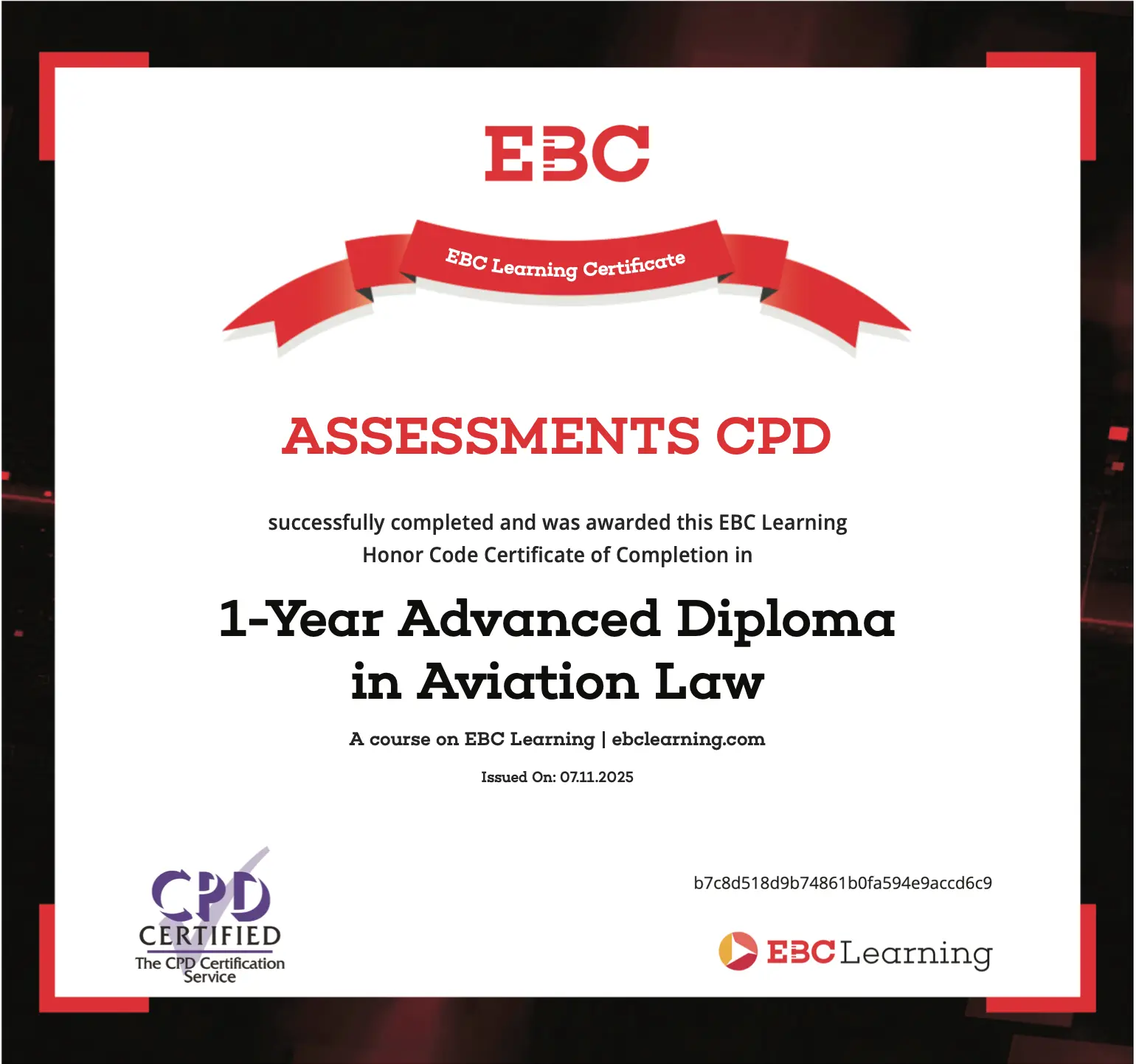
Upon successful completion of this course, you will be awarded a CPD-Certified Advanced Course Certificate from EBC Learning.
This certification is accredited under the CPD framework and reflects successful completion of structured assessments and learning hours. It is issued by EBC Learning, backed by Eastern Book Company’s legacy of over 80 years in legal publishing and professional education.
The certificate carries CPD recognition and validates your continuing professional development in Aviation Law and Regulation.
Limit Reached or Trial Expired
You have reached the limit of 2 audit enrollments or your trial period has expired.